You close a book with twenty new highlights. A week later, one of those ideas would help with a decision at work, but you cannot bring it to mind. When you open the book and find the passage, it looks familiar immediately.
That familiar feeling is useful, but it is not the same as recall. The words on the page are doing part of the work for you. If you want to use the idea when the page is closed, you need to practice retrieving it without seeing the answer first.
An active recall prompt turns a saved passage into a small question. You attempt the answer, reveal it, and judge how well you remembered. This guide explains how to save passages that make fair prompts, how to choose between Cloze and Q&A, and how those recall modes work inside Acorny.
Highlighting saves an idea. It does not test your memory
Highlighting solves a real problem. It preserves a sentence, keeps the source attached, and gives you a way to find the idea later. Without that capture step, many useful passages disappear as soon as you turn the page.
The problem starts when capture becomes the end of the workflow. Scrolling through old highlights mostly asks, "Does this look familiar?" Familiarity can arrive before you can explain the idea, distinguish it from a similar idea, or apply it to a new situation.
Try a simple check. Hide a highlight and ask yourself what it said. If you can reconstruct the point in your own words, you recalled it. If you need to see the first few words before the rest comes back, you recognized it. Both experiences feel like knowing, but only the first one tests whether the memory is available when the source is absent.
Highlighting is the input to a second process. Save the passage first, then decide whether the idea is important enough to practice.
Why retrieval helps with delayed retention
A recall attempt changes what happens during review. Instead of receiving the answer again, you have to produce it.
In Test-Enhanced Learning, Henry Roediger and Jeffrey Karpicke asked students to study prose passages and then either restudy them or take free-recall tests. Restudying helped on a test five minutes later. On tests after two days or one week, the students who had practiced retrieval retained more. The experiment does not mean that every question works or that rereading has no use. It shows why another exposure can feel productive while giving a weaker picture of delayed recall.
Timing matters too. If you answer the same question again thirty seconds later, the previous answer is still easy to recognize. A delay makes the next attempt less automatic. Nicholas Cepeda and colleagues reviewed this broader pattern in Distributed Practice in Verbal Recall Tasks. Their quantitative review found a general advantage for distributing study over time rather than concentrating it into one session, though the best interval depends on how long the learner needs to retain the material.
A later review of ten common learning techniques reached a similar practical conclusion. Dunlosky and colleagues rated practice testing and distributed practice as high-utility techniques. They rated highlighting and rereading lower because those methods did not consistently improve performance across the conditions they reviewed.
These studies examine learning techniques, not Acorny. They support the two decisions behind an active recall workflow: attempt an answer before looking, then return to the question after some time has passed.
Which highlights make useful recall prompts?
Every highlight you save or import into Acorny can enter review. Changing its recall mode to Cloze or Q&A changes how Acorny tests the same highlight. If you accept an AI-generated Q&A candidate, Acorny adds a separate card for that question and answer.
That makes the capture decision important. A passage that is useful for reference but has no clear retrieval target can still create review work later.
Good candidates usually contain one idea that you expect to use again:
- A definition you need to recall without looking it up.
- A cause-and-effect relationship that explains why something happens.
- A decision rule you want available during real work.
- A principle that transfers to situations beyond the original example.
- A distinction between concepts you tend to confuse.
Some passages are better left in the original source. A sentence may be beautiful without being useful as a question. A fragment may depend on the paragraph around it. A fact you already retrieve easily does not need another place in your review queue.
Before saving a passage for review, ask two questions:
- In what situation would I want to recall this?
- Can I write one prompt with a reasonably clear answer?
If you cannot answer the first, leave the passage in its source. If you cannot answer the second, capture more context, split the idea, or skip it.
Turn one highlight into one useful prompt
Suppose you saved this sentence:
Spacing review sessions makes recall more effortful, which gives you a better test of whether the memory is still accessible.
A weak question would be:
What is spaced repetition?
That question reaches far beyond the saved sentence. A good answer could cover review intervals, scheduling algorithms, forgetting, or study habits. When you reveal the source passage, it cannot tell you whether your broad answer was right.
For a Cloze card, keep the original sentence and select effortful as the hidden term:
Spacing review sessions makes recall more ______, which gives you a better test of whether the memory is still accessible.
The sentence supplies context while leaving one target to retrieve. This works well if the relationship between spacing and effort is the part you want to remember.
For a manual Q&A prompt, turn the same idea into an explicit question:
Question: Why can spacing review sessions improve the value of a recall attempt?
Your answer before reveal: Because the delay makes retrieval less automatic, so the attempt tests whether the memory is still accessible instead of relying on immediate recognition.
Manual Q&A stores the question. When you reveal the answer, Acorny shows your highlight note if one exists, or the original passage as the suggested answer. The response above is what you might try to produce before reveal. If you use an AI-generated Q&A candidate, Acorny drafts a separate question and answer that you can edit before accepting it.
Both recall modes have one target. The right choice depends on what you need to retrieve.
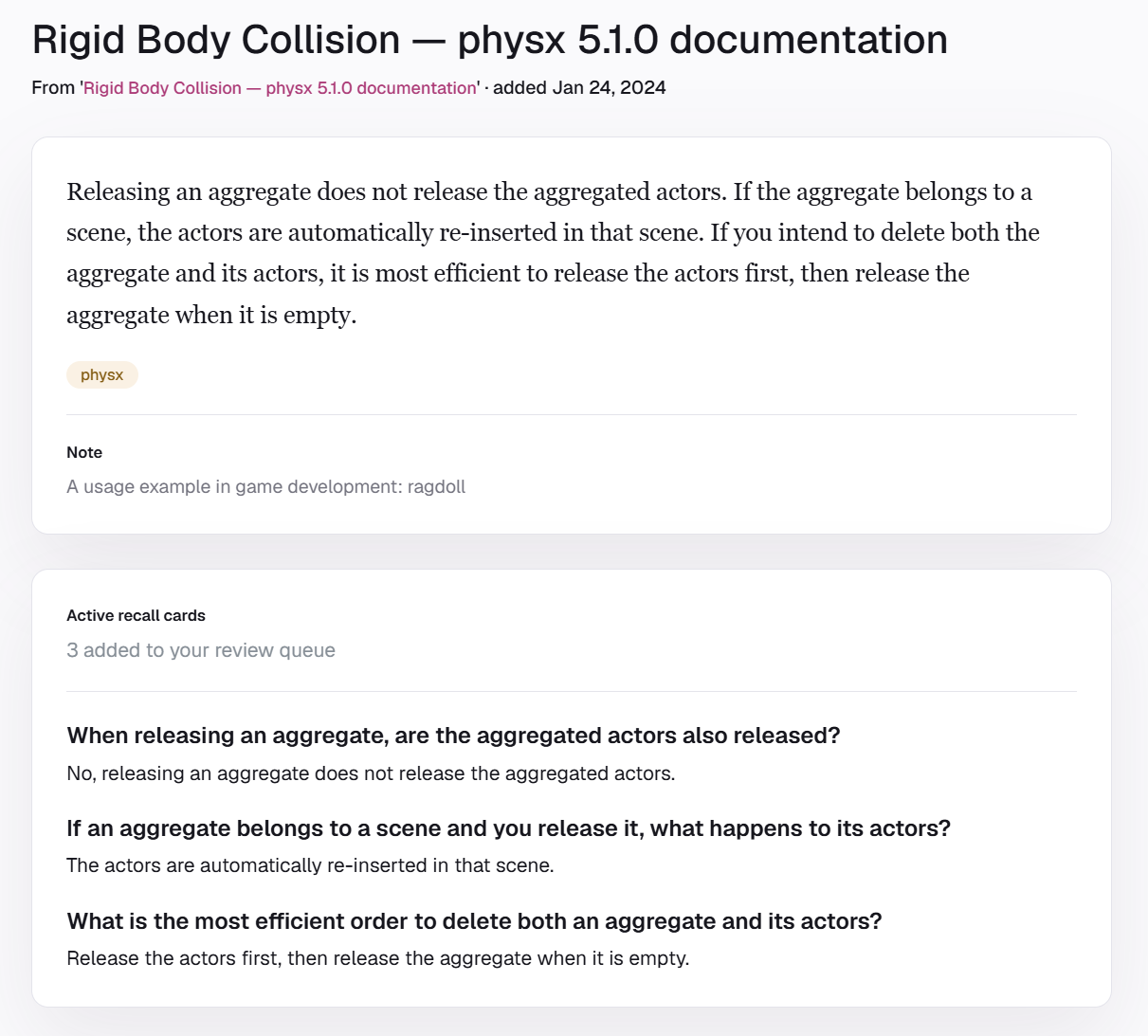
One saved passage keeps its source, note, tag, and active recall cards together.
Choose Cloze or Q&A based on the idea
Cloze preserves the wording and context of the highlight. Q&A gives you more control over the prompt. Neither format is better for every passage.
| Material | Use | Reason |
|---|---|---|
| Term, short definition, fixed relationship | Cloze | The original sentence provides useful context around one missing term |
| Explanation, comparison, cause and effect | Q&A | The question defines the retrieval target without exposing the answer |
| Broad or ambiguous passage | Edit or skip | A card with several valid answers is hard to review consistently |
In Acorny, a Cloze card starts with the saved highlight. You select the term or terms to hide, then check the preview. You do not need to rewrite the whole passage in a special notation.
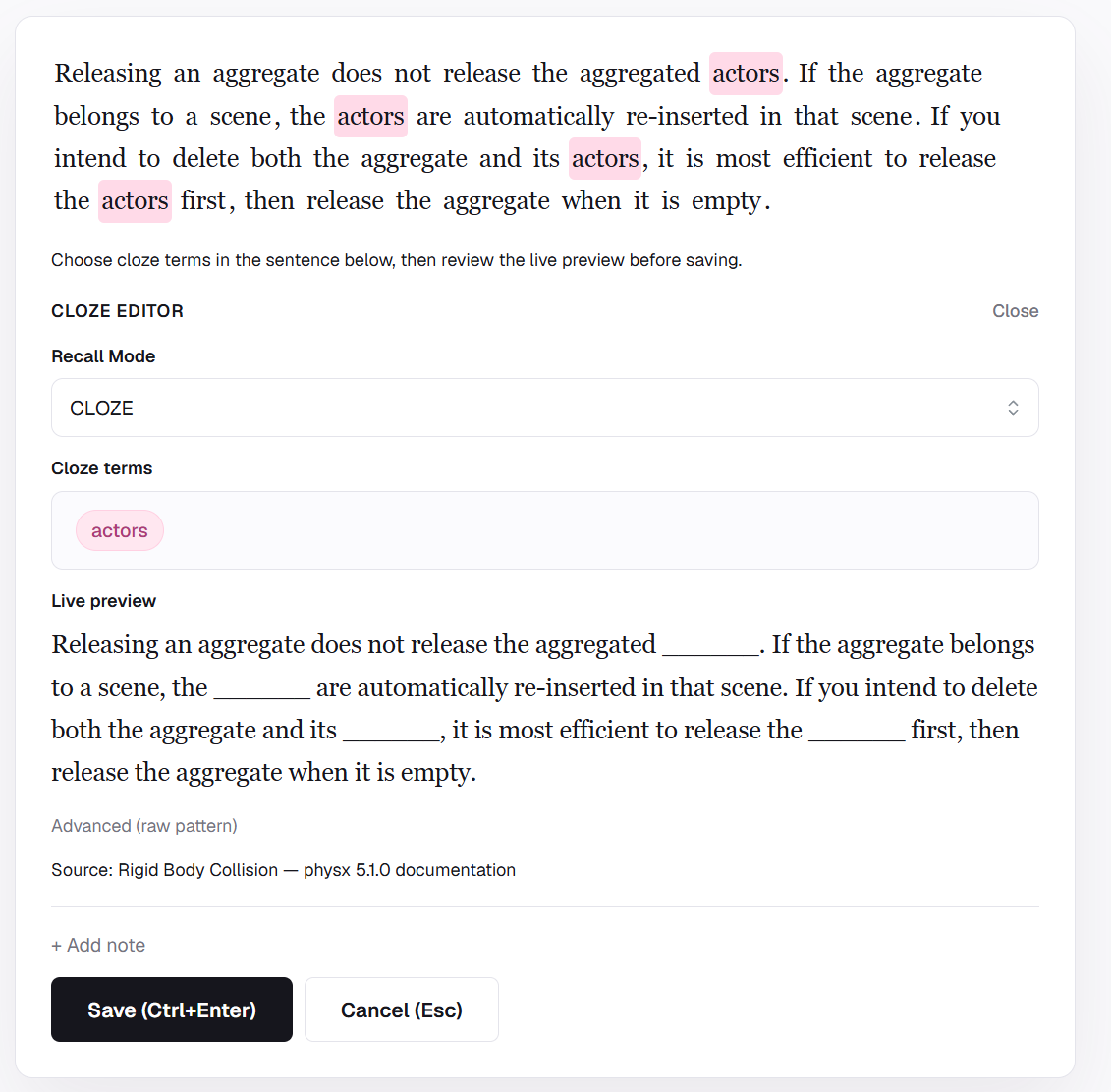
Select the term to hide, then check every blank in the live preview.
A manual Q&A prompt stores a question. On reveal, your note or the original highlight acts as the suggested answer. This mode fits passages where you want to ask why, how, or under what conditions an idea applies.
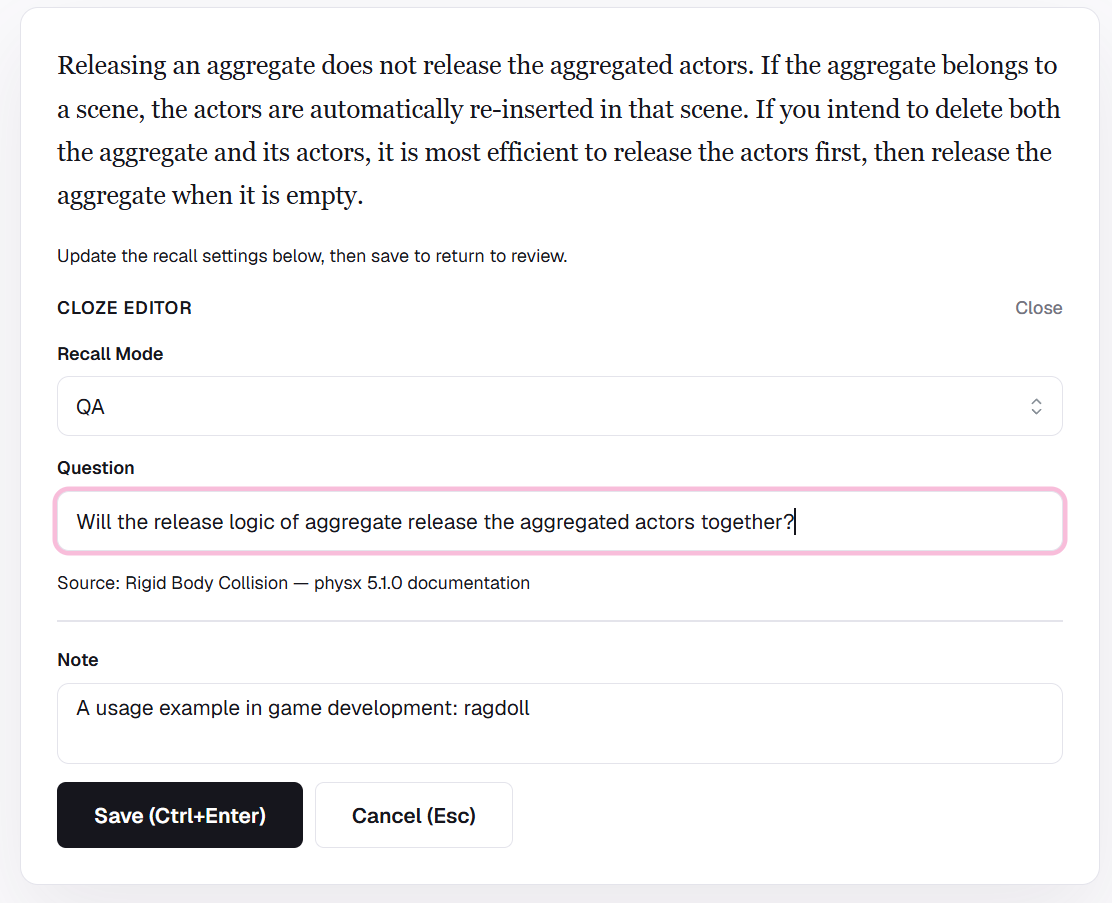
Manual Q&A keeps the prompt editable and uses the note or highlight on reveal.
Acorny can also draft a separate question and answer with AI. Treat that output as a first draft. Check it against the source, narrow vague questions, and remove details that the passage does not support. You can edit both fields, then accept the candidate to add its AI Q&A card to review.
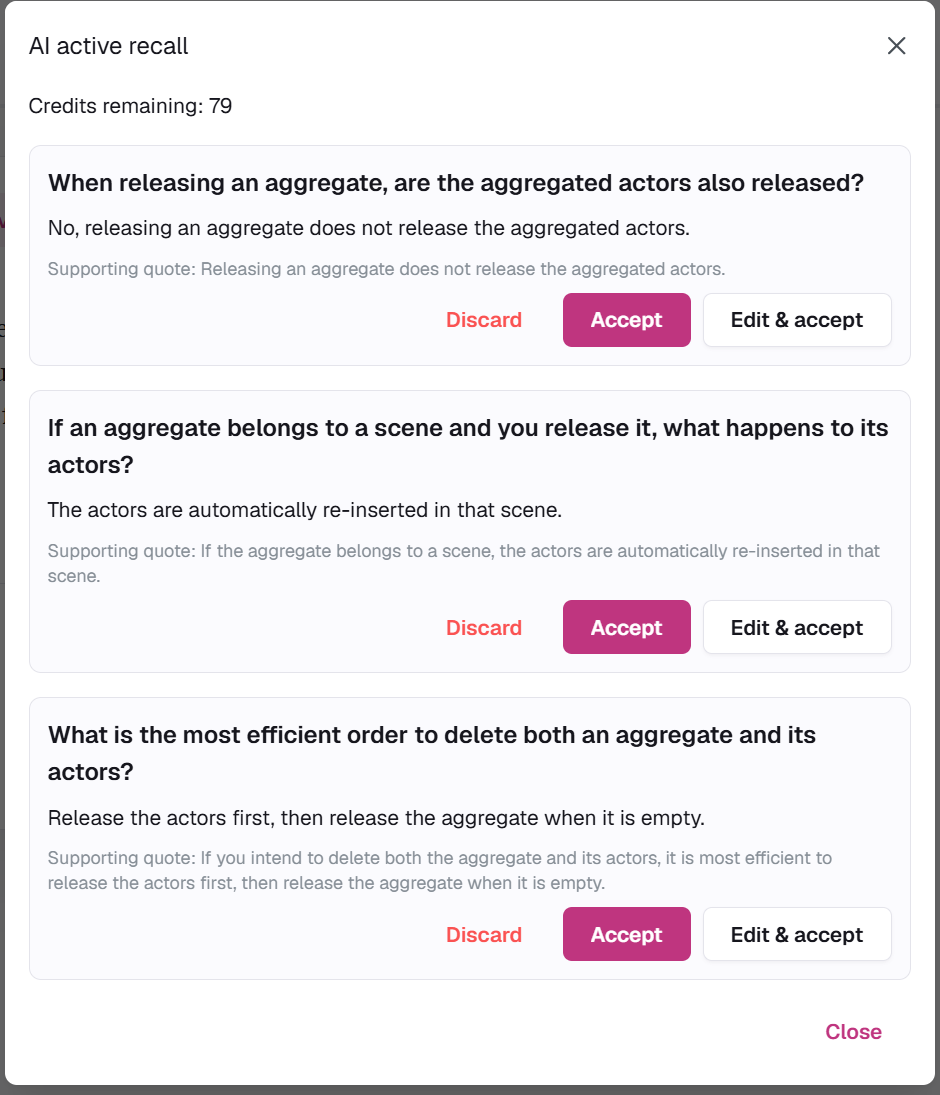
AI-generated candidates remain drafts until you accept or edit them.
A simple workflow in Acorny
You do not need to process your whole library before the first review. Start with one reading session and let the workflow stay small.
- Capture a focused passage from the web, import Kindle clippings, or import your Readwise library. The list of supported highlight sources shows the available import paths.
- Acorny adds the saved highlight to review using your default recall mode.
- During review, use Quick Edit to select a Cloze term or write a manual Q&A question. You can also review an AI Q&A candidate and edit its separate answer before accepting it.
- When the prompt is due, attempt the answer before revealing it. Say it aloud, write a short answer, or form it clearly in your head.
- Reveal the answer and choose Again, Hard, Good, or Easy. Acorny uses that rating to schedule the next appearance.
The Acorny Quick Start covers the capture and review controls if you want to try the full flow with a new highlight.
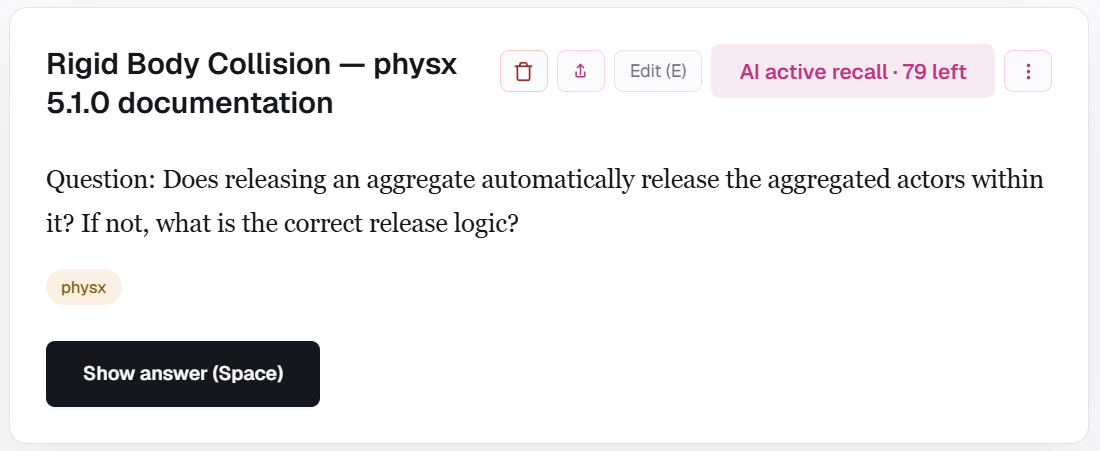
Review starts with the prompt and no visible answer.
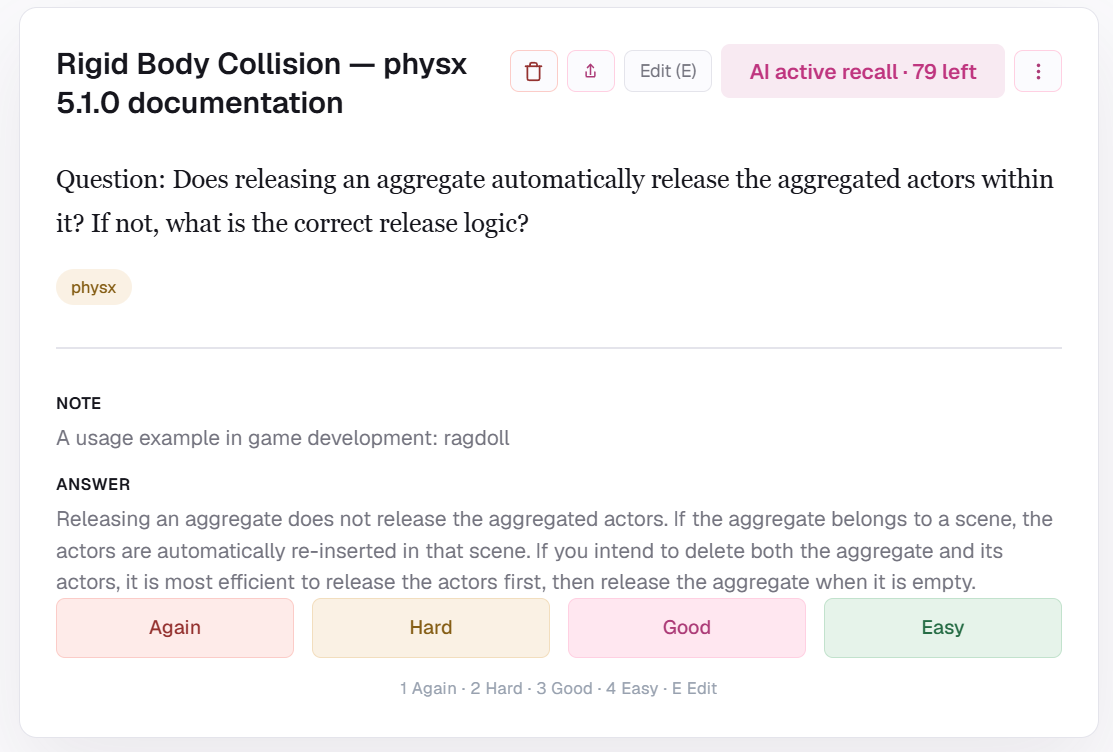
After reveal, compare your response with the answer and rate the attempt.
Four mistakes that make cards harder to review
Asking several questions on one card
"What does this concept mean, why does it work, and when should I use it?" is three review decisions hiding in one prompt. You may remember two parts and miss the third, then have no consistent way to rate the attempt. Pick the part you need most or split the prompt.
Removing the context that makes the answer fair
A short question is not always a clear question. Names, technical terms, and conditions from the source may be necessary. Keep enough context to identify the idea without including words that reveal the answer.
Saving passages you do not want to review
Every saved highlight can enter review. Ten weak highlights from every chapter can bury the one principle you wanted to remember. Capture passages that have a clear future use instead of treating the Save action as a reading counter.
Creating the card before understanding the source
A polished prompt cannot repair a misunderstood passage. If you cannot explain the highlight while looking at it, read the surrounding section first. Write the card after the idea makes sense.
Start with five highlights
Choose five passages from something you read recently. For each one, name a situation where the idea would be useful before saving it to Acorny. Change the recall mode to Cloze or Q&A when that format gives you a clearer retrieval target than the default review.
Review those cards before adding more. The first review will show which prompts feel precise and which ones make you argue with the answer. Edit the second group before expanding the set.
When you are ready, start reviewing with those five. Check whether each prompt feels fair after the answer appears. Fix the weak prompts before bringing more sources into the queue.